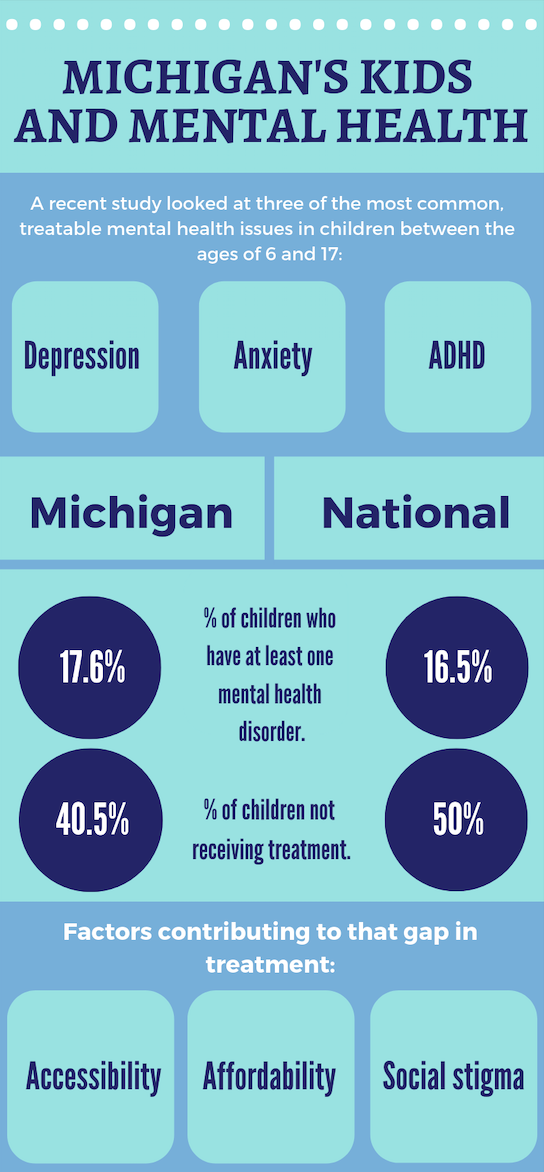
Exclusionary discipline rates are substantially greater for trainees of color and students in special education class. 78% of children with depression have received treatment, whereas treatment for stress and anxiety and behavioral/conduct problems was 59% and 54%, respectively. Without access to services, trainees with anxiety are at higher risk of later establishing anxiety.
Children from low earnings, Hispanic and African American households are less likely to be diagnosed and dealt with based on limited access to care. Predispositions related to medical diagnosis of behavioral conduct issues are most widespread with African American students. Closing the treatment space in schools starts with more financing so that districts can bring more therapists and psychologists onboard - essential forces for school security before and after terrible events.
At Amanda Greene-Chacon's school in Oregon, lots of trainees never ever have the chance to consult with these trained professionals. "There is a mental health crisis in our schools," she told The Register-Guard. "The primary and intermediate schools do not have appropriate varieties of psychological health experts. At the high school level, we are seeing unmatched levels of troublesome, rude and even threatening behaviors." Greene-Chacon, a member of the Springfield Education Association, likewise thinks the "the real problem is the method we serve our trainees in overcrowded classrooms where the pressures of standardized testing have robbed instructors of their capability to supply age-appropriate academic chances." Liz Hurt, a school nurse in Oakland, California, says the addition of nurses in schools causes quantifiably more time for teachers to educate their trainees in the class instead of concentrate on other requirements.
Mental health specialists highly believe beginning early produce better outcomes in later years, but the absence of programs and services offered to preschool children is glaring. "For both stress and anxiety issues and behavioral/conduct problems, treatment receipt was more common among school-aged kids compared to those aged 3- to five-years," the report stated.
Something real for almost everyone reading this is that our everyday lives as kids were defined by going to school. We learned brand-new things, manners, and how to cope with other people, and we made brand-new buddies. Enjoyable, right? However, nowadays, high school has handled an entire new meaning for teenage students.
Practically all of us probably understood at least one kid in school who was worthy of a good lesson in good manners. Well, the American Society for the Favorable Care of Kid has actually discovered that 28 percent of all kids aged 12 to 18 have struggled with bullying. Bullying is a great nuisance for trainees, for it turns the school from a healthy knowing environment to a scary no-man's- land.
If a victim is physically bullied, he might fear for his immediate safety. Plus, informing a teacher or grownup can be frightening, especially if the bully threatens to be much more vicious if an adult is involved. A young trainee can easily be daunted by the class bully. And if the bully turns the school into a place connected with being beaten or getting their money or food stolen, why would a child want to go, not to mention go there to discover and work? If you walk through a high school's hall, you'll most likely see a lot of drowsy trainees with unlimited bags under their eyes.
Some Known Details About How Does Mental Health Affect Physical Health
When asked how they felt in school, 39 percent of the trainees just responded to that they were tired - how toxic relationships affect your mental health. Indeed, following classes all day is hard enough without needing to get up at 6:00 AM to catch a 6:30 bus. Contribute to that after-school activities, stress, homework, and deadlines, and you can end up exhausted pretty quickly.
A healthy quantity of sleep for a teen in high school is in fact 9.5 hours, however usually, they just get 7 - how does diabetes affect mental health.5. Not getting sufficient sleep can make a teenager irritable, exhausted, and depressed, which causes a failure in grades. Agoraphobia can be a significant cause of panic attacks, and if we have a look at schools, they are loaded with seemingly endless masses of trainees scurrying from one class to another.
Anxiety attack can be very frightening, and clearly, a trainee who routinely experiences them can not study effectively. Trainees experiencing panic condition are typically distracted in class or brought away by their ideas, which is why they can quickly be overwhelmed if strained with details. Panic attacks can also be spurred by the fear of an approaching occasion or overthinking something, such as a test, the effects of a bad grade, and so on.
It's no surprise that more than six percent of teens are taking prescription psychiatric drugs. These can be for anything from anxiety to ADHD, which can trigger a student to easily get distracted and misplace what is happening in class, making it dreadfully simple to fall behind on their notes, making it harder to get ready for tests or projects, even more digging a hole in their grades.
This causes them having a lower view of their intelligence compared to other students when, in truth, it is not related to their mental capacity. Typically, the issue is not related to their intelligence but rather to an absence of motivation to maintain and pay more cautious attention.
Grades are scary, and school is harder than ever. How better to evaluate trainees than to put them through a series of stressful tests that may or may not define their future? Well, let's have a look at how lots of students aged 13 to 18 report having test stress and anxiety: 25 percent.
It just becomes worse after that because of the significance American high schools provide to grades and results. If a student fails their final tests, it can have effects for their college and ultimately their career. When such an emphasis is put on a test, so simple to stop working if we get the responses wrong, it's just typical to be stressed.
Not known Factual Statements About How Does Mental Health Affect A Person's Job
Even if one trainee has better memory than http://felixhohm782.raidersfanteamshop.com/6-simple-techniques-for-how-does-stress-affect-your-mental-health another, it does not specify his intelligence. Trainees can be exposed to a great offer of worrisome scenarios in high school, such as due dates, social relationships, fear of failure, and so on. The frustrating amount of things students need to Drug Rehab Center consider, keep in mind, and hand in is merely frightening.
Stress makes it really challenging to work, handle school, and have healthy social relationships, which we typically forget is critical to a kid's advancement. In numerous ways, the obstacles that face Substance Abuse Treatment trainees in high school just make matters worse, with social relations at school being a growing number of hard and numerous subjects requiring oral presentations.
And, let's be truthful, even for those who do not already struggle with anxiety, speaking in front of a crowd is not constantly simple (how does music affect mental health). Being a teenager is hard enough without having to deal with hard times at school; it can cause a trainee sensation sadder and sadder for weeks or perhaps months.
They detach themselves more and more from school, the teachers, whatever, hindering their psychological health and, obviously, their grades. The fatigue typically felt by teenagers at school only makes matters worse. As lots of as one teen out of 5 experiences depression before going into the adult years. In severe cases, depression may cause self-harm and even suicide.